“I call them luminous sculptures; lamps that are a bit strange.”
— An Interview with Gianfranco Fini
Roman-born Gianfranco Fini is a man of many talents. Artist, architect, set designer for opera and film, and designer of extraordinary lighting objects for the company New Lamp. To meet with him personally, we travel to the Dominican Republic where he has lived and worked for a long time. Energetic, acute and elegantly dressed he picks us up personally, and driving through Casa de Campo he points out some of the many villas he designed. We sit down in his architecture studio—now headed by his daughter Nicola—to have a look at his archive. The following conversation is translated from Italian.
-
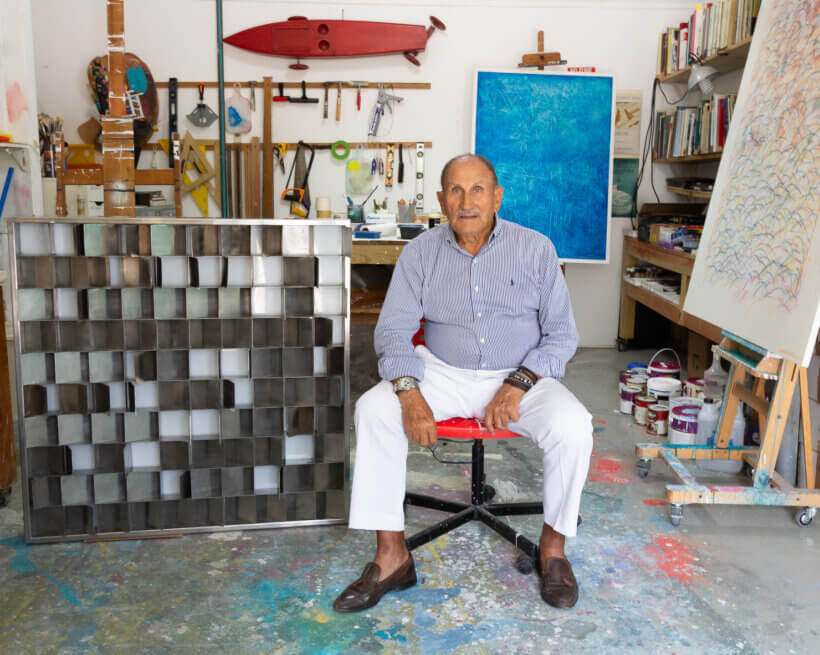 Above: Gianfranco Fini in his painting studio with lighting sculpture Programma (Picture by Palainco).
Main picture: Gianfranco Fini, adjusting the flaps of lighting sculpture Programma, designed by Gianfranco Fini and Fabrizio Cocchia, manufactured by New Lamp, circa 1970 (Picture by Palainco).
Above: Gianfranco Fini in his painting studio with lighting sculpture Programma (Picture by Palainco).
Main picture: Gianfranco Fini, adjusting the flaps of lighting sculpture Programma, designed by Gianfranco Fini and Fabrizio Cocchia, manufactured by New Lamp, circa 1970 (Picture by Palainco).
-
“I have lived here for more than thirty-five years now. I think that often things happen by chance, it was a series of coincidences. I was approached by a friend of mine to design his home in the Dominican Republic, which I didn’t even know existed. I had heard about it, but I didn’t know exactly where it was. And when I came here, I naturally fell in love with the place because it is a kind of Eden. I built his house and then there was a whole chain of consequences. There were other people who needed a house, they liked the house I had designed for my friend and so I was called again. And the amount of work increased.”
Could you have foreseen that you would end up here?
“It happened by chance, it was coincidental.”
-
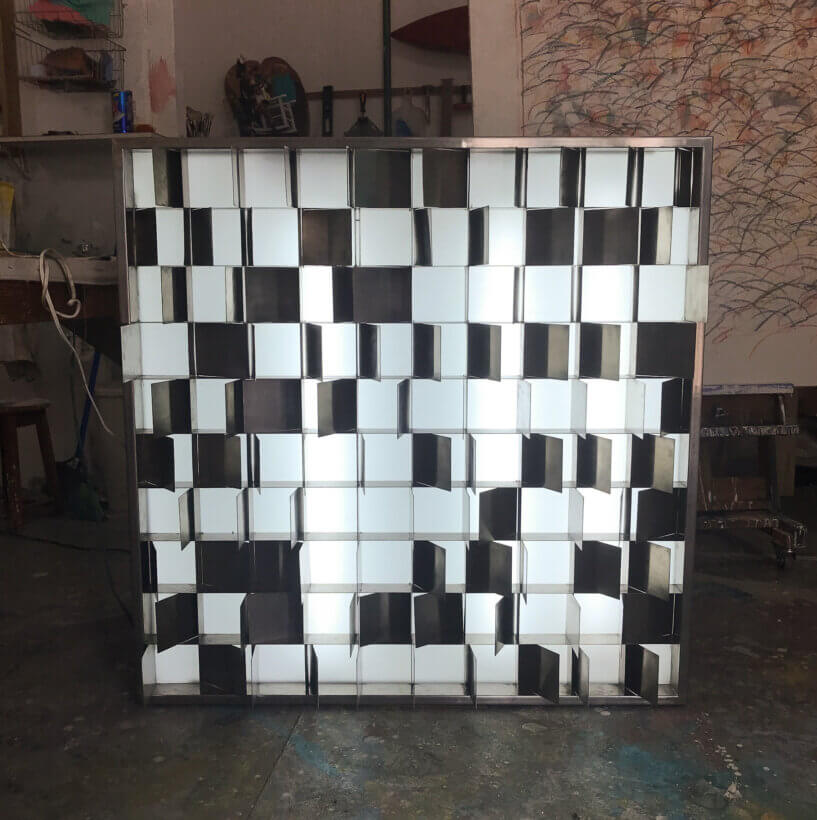 Lighting sculpture Programma, designed by Gianfranco Fini and Fabrizio Cocchia and manufactured by New Lamp, circa 1970 (Picture by Palainco).
-
He takes us to his painting studio, adjacent to the office. It is filled with large new works, clearly the fruit of vitality and inspiration, of which he says: “I paint subconsciously”. With the help of his assistant, he carries a large object packed in bubble wrap out from behind the paintings, unpacks it, and puts it down on the floor. And there it is, Programma, in all its splendour, in the middle of the studio…
“I used to have it in my home, mounted on the wall, and in the evening I used to switch it on, in the large villa I had with all the artworks that I showed you pictures of.”
It was the first lamp that you made, Programma, and what a spectacle! How did the collaboration with New Lamp come about?
“I had a very peculiar relationship with the craftsman who was the owner [Mario Vento—Palainco]. The first time I went to see him in his factory it was very dark; there really was hardly any light. But I noticed several interesting machines that could work metal, and I consulted with him and his workers. I stood there with my drawing in hand, and explained to them how everything worked. He was a Roman that spoke Romanaccio [literally: the ugly Roman dialect—Palainco]. He started muttering in dialect with two or three of his workers, technicians who were in charge, and he went outside with them. When he came back, he said: ‘Se po’ fa…’ [‘It can be done’—Palainco], and that was it.
I was surprised, because when I presented the design, I was convinced that he would say to me: ‘To hell with it, it can’t be done’, because it’s a very complicated one to carry out. You see, there is a little hole here with a little nail inside, which needs to fit well and there is a structure that is completely welded. And these plates here are crossed. So, everything needs to be assembled well. And everything is made by hand.
Later they called me when the model was ready, the prototype. When I arrived in the factory, I really liked it. It was magnificent, because the factory being quite dark, the backside seemed illuminated very brightly.”“It needed to be something artistic, an object that had a sense.”
-
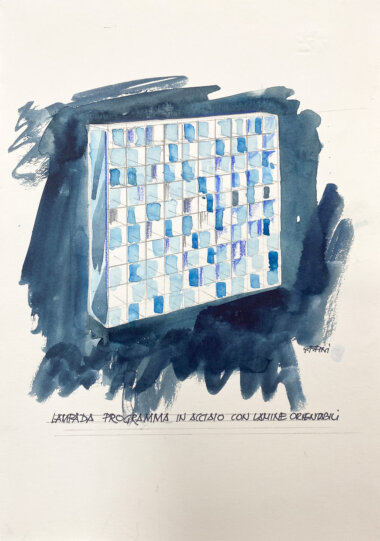 Left: Original drawing of lighting sculpture Programma by Gianfranco Fini. “The basic idea was there, and how to make it came out by collaborating with them.” (Picture by Palainco).
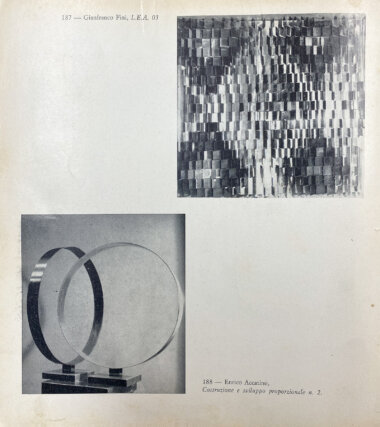
Right: Upper sculpture: Kinetic sculpture LeA in stainless steel, by Gianfranco Fini. It was exhibited at the Sixth Biennale in Rome in 1968. According to Fini it was a precursor for lighting sculpture Programma (Picture: Catalogue Sesta Biennale Romana).
Left: Original drawing of lighting sculpture Programma by Gianfranco Fini. “The basic idea was there, and how to make it came out by collaborating with them.” (Picture by Palainco).
Right: Upper sculpture: Kinetic sculpture LeA in stainless steel, by Gianfranco Fini. It was exhibited at the Sixth Biennale in Rome in 1968. According to Fini it was a precursor for lighting sculpture Programma (Picture: Catalogue Sesta Biennale Romana).
-
Did you encounter any difficulties during production, leading you to adapt the design?
“No, no… and besides, they also made suggestions… They helped me solve some problems and therefore I often went over to watch. I had a precise idea in my mind and I had made the drawing that I showed to you. And talking to them, in my role of the architect, we got on very well. The basic idea was there, and how to make it came out by collaborating with them. They understood everything well; Italian artisans, I think, are still among the best in the world.”
After Programma how did things evolve further? Were you free to do what you wanted, or did you get requests?
“No, no… Whatever I proposed was accepted; since Programma was really very complicated, the others got accepted as well. I had a thousand things in my head, so I had to make up something specific. There were similar characteristics that were fine with me, which was that it needed to be something artistic, an object that had a sense. I also have other drawings, somewhere, of other lamps that could go into production, so the intelligence is mine.”
Before you started designing lamps you had made a kinetic sculpture that was shown at the Sixth Biennale in Rome in 1968. It was a precursor to Programma. If I’m not mistaken, LeA, or Luce e Arte [Light and Art— Palainco]?
“Not exactly. There is a hidden meaning behind that name…”
Ah… Really?
“…because at one point when I was a cinema set designer, I met an Italian actress called Lea Padovani, and I fell in love with her. She also fell in love with me, and we had a love affair. I was married at the time, and afterwards I made this sculpture in her honour. It was called Luce e Arte, LeA, but my wife understood it very well.”
It was not so difficult! [We laugh]
“It wasn’t difficult. And LeA is indeed the precursor to Programma.”
Programma is interactive, as the owner can regulate the light?
“Exactly. Programma was born thinking of LeA, which intervenes on a regular fabric with partial modifications that create a sense of rupture and not necessarily a design, but a rupture.”
It’s a kinetic sculpture, isn’t it?
“Yes, but it’s fixed, you can’t move it. The most enjoyable thing about Programma, compared to the other lamps I have made, was that there was a customisable element to it, so that everyone could make the picture they wanted by moving or closing the blades. This kinetic part, which allows the owner to decide on the amount of light that he wants, the same goes for another model: Riflessa. By moving things the person who owns the object can adapt it.”
“I have this defect that has limited my ability to succeed, because for me everything is very easy.”
-
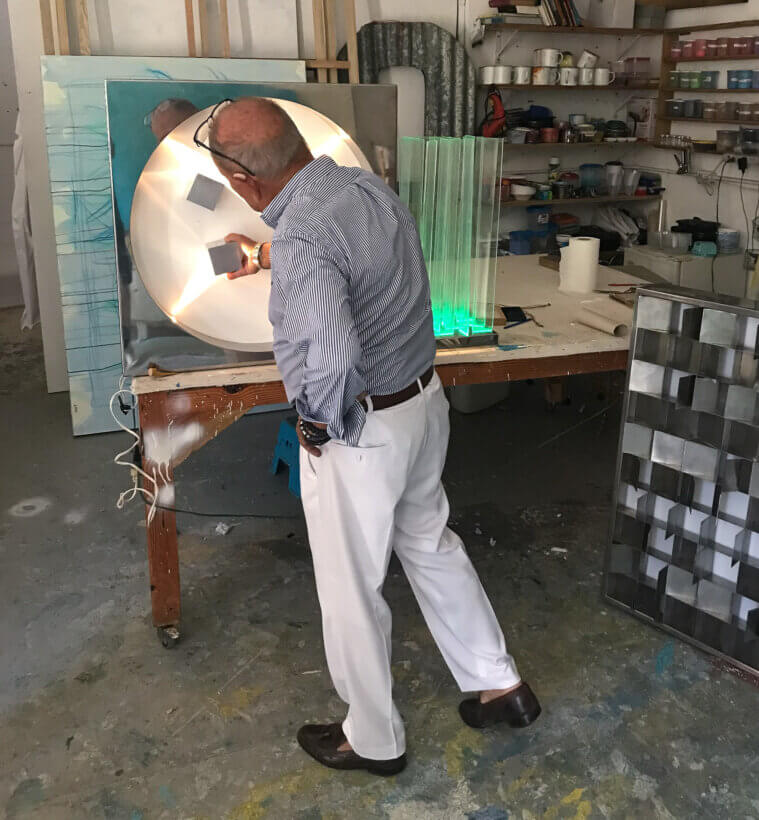 Gianfranco Fini with lighting sculpture Riflessa, moving the aluminium cubes to obtain the desired effect. “By moving things the person who owns the object can adapt it.” (Picture by Palainco).
-
“I have always drawn well. I remember vaguely that in elementary school I was awarded for a drawing that I had done. I found drawing easy, which always surprised me, all these years. When I was in middle school, I noticed that others had one quality that I didn’t have: people who made very crude drawings were enthusiastic about their own work, while to me it seemed that they had done a horrible thing. But they found it extraordinary themselves. I have this defect that probably has limited my ability to succeed, because for me everything is very easy. Consequently, I never give importance to these things, and even when I get compliments about my designs I say: ‘Yes, it’s fine, but there’s probably something that I missed.’ I’m happy the way I am, but there are a lot of people, especially architects, who reach a level of success because they have a superior opinion of themselves, which helps them. I don’t have that.
I did liceo artistico [secondary school focusing on art—Palainco], where I practised various types of drawing, history of art and Italian literature. In short, it was fun and satisfying. In the fourth year, Guttuso [painter and politician Renato Guttuso—Palainco] taught at our school. He was a famous artist at the time and is underestimated today. He complimented me and, naturally, I did my drawings somewhat in his style.”
Were your parents artistic? Your father worked as a tailor.
“Yes, he painted, he was a real Sunday painter. He was a tailor, who strangely enough worked only for priests. That, too, came about by chance. I don’t know how it came about, because ninety-nine percent of tailors are laity tailors; there are very few ecclesiastical tailors. It’s also rare for a tailor to work in his own house; I used to get kicked out of the living room when I was studying, if he had to cut a cassock.”
It almost seems like a scene out of an Italian film from the era… [We laugh]
“Yes, just think about how it’s possible for an ordinary tailor to become an ecclesiastical tailor… The only thing that comes to mind is that the Università Gregoriana, which was the university attended by all the priests of the world that become bishops or cardinals, was close by.”
-
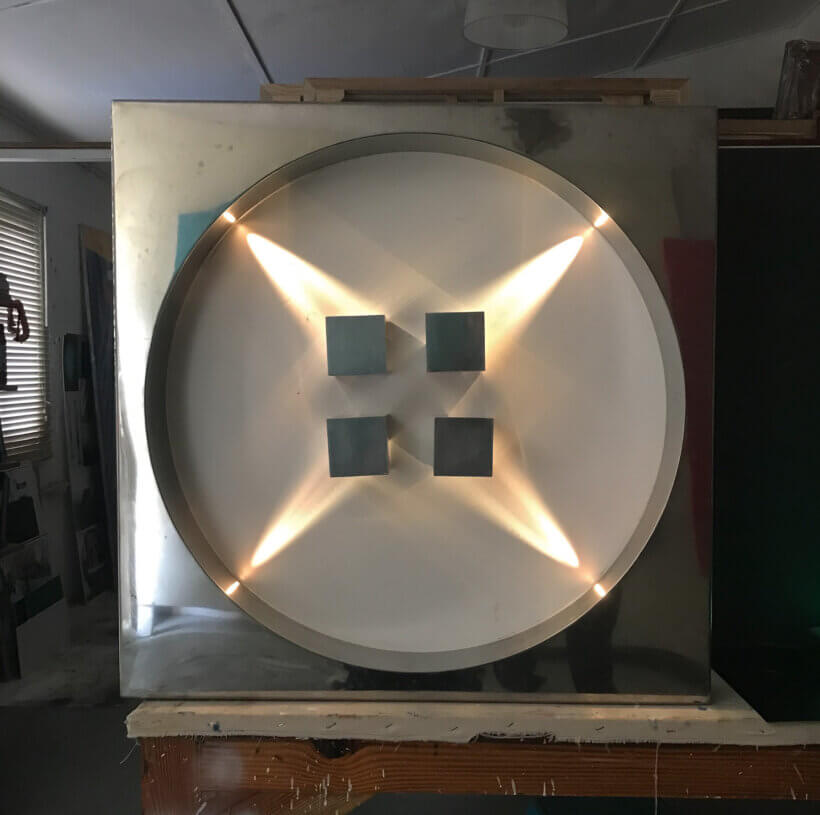 Lighting sculpture Riflessa, from Gianfranco Fini's personal collection, designed by Gianfranco Fini and Fabrizio Cocchia, manufactured by New Lamp, circa 1970 (Picture by Palainco).
-
In his painting studio, Fini and his assistant now put Riflessa on a table. We admire it while Fini moves the aluminium cubes to obtain the desired effect.
“In my opinion it’s not a lamp that worked out exactly as I had in mind, because the surface of the cubes with the magnets should have been more reflective, like a mirror. That’s why I wanted to use steel instead of aluminium. Now they are aluminium, because of gravity. The backside of the lamp is made of steel, but if the cube parts were also steel it would’ve been much better, because then they would reflect perfectly. So, it didn’t quite turn out as intended. The other thing is the light source that is used. It must be punctiform; it cannot be a beam that widens. The punctiform light is the one that is used for example in cinema, in projectors, in order to send the image onto the screen. The light must be of great intensity, and punctiform. It works well enough, though: the back shows the play of light.”
Does it mean that you were not completely satisfied with the result?
“No, I wanted the game to be more evident, because it’s obvious that the number of combinations is practically infinite. Just imagine, there are four cubes with four points of light, and four sides within, where the light is reflected from all sides and the reflections of the others can interfere with each other… This here [he points at the centre part of the lamp] should have been a tangle, had it been made as I intended. It could have been a lamp that you would want to briefly play with to make designs.”
Then why didn’t you go any further?
“I don’t know. It happens to projects; it always depends on other factors and other people, the culture, and a thousand things that interfere. I respect my friend Mario Ceroli [the artist Mario Ceroli, with whom Gianfranco Fini has done several important projects—Palainco], who is insistent, whereas I give up on certain things. I Iet go. There are people whose hearts are made in a certain way, who insist. I’m not like that, it’s a character thing.”
Anyhow, both Programma and Riflessa seem to have turned out very well.
“Thank you.”
-
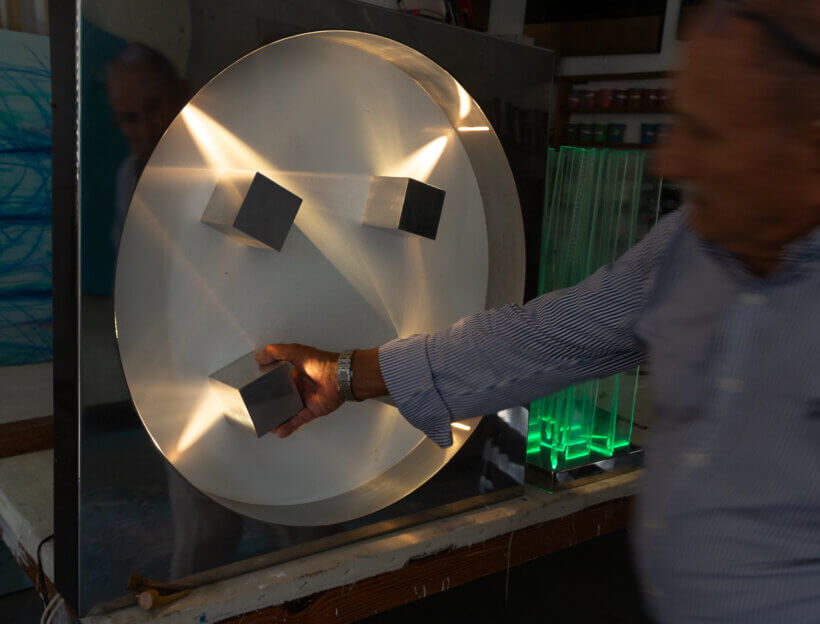 Gianfranco Fini demonstrating some possibilities of Riflessa. Like Programma, Riflessa is an interactive object: “It could be a lamp that you would want to briefly play with to make designs”, according to Gianfranco Fini (Picture by Palainco).
-
You were quite determined to go to Paris for a year after school since you wanted to become a painter, much against the will of your parents. What did you expect to find there?
“I thought that Paris could give me a broader dimension and it did, because by visiting the museums I saw the most important paintings of the twentieth century. I wanted to understand what I wanted to say, and become a painter. But France was too far out of my reality, too far from my roots. It didn’t work out.
Now I think that if I hadn’t gone to Paris, I would have been more determined to become a painter. I can’t, of course, think retroactively, but I think it was a mistake to go. I already hung out with the Scuola di Piazza del Popolo [a group of artists in the 1960s in Rome including, among others, Mario Schifano, Franco Angeli and Tano Festa—Palainco]. If I had stayed in Rome, I would have joined the group and become one of the best. I now understand that from these psychological sessions you are subjecting me to.
When I came back from Paris, I resumed contact with my friends, but it was more the bohemian life that fascinated me and the great themes that were discussed, because we were all very young and very full of energy and curiosity. And I decided to study architecture. At the time of the first exhibition of the Scuola di Piazza del Popolo, I had already enrolled in university. I led a double life, as I went to university during the day and hung out with my artist friends in the evening. I was an architetto anomalo [an anomalous architect—Palainco], with one foot in architecture, and one foot in modern art. And I never stopped painting.”
After having lived in villas of his own design Fini now lives relatively “minimalistically” as he calls it, in an apartment that is part of the village that surrounds the marina, which he also designed. The village includes buildings that look like fisherman’s dwellings, similar to those that can be found in the Mediterranean. He designed the entire complex. Fini’s home, where we meet for the second time, is filled with furniture of his own hand, paintings, prototypes and sculptures, many of which were made by his friends, like Tano Festa, Mario Ceroli and also Andy Warhol.
“I looked at every strange form to see if it could be translated into a luminous shape.“
-
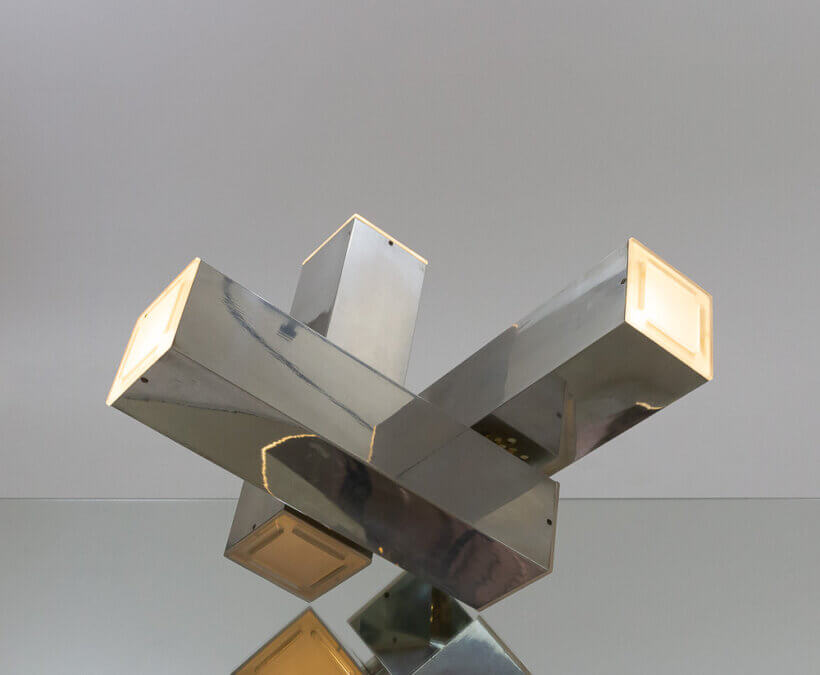 Lighting sculpture Ascissa, designed by Gianfranco Fini and Fabrizio Cocchia and manufactured by New Lamp, circa 1970. It consists of satin aluminium tubes and milky white methacrylate caps (Picture by Palainco, Palainco private collection).
-
[He points at pictures of table lamp Ascissa] “You know this one very well [as we told him earlier that we have it in our private collection—Palainco]. It is made of aluminium. It’s very simple. You see that there are three pieces with slits for air circulation: two horizontal pieces, and one vertical piece. They are the three principles of the axes: there is one looking in this direction, one in this direction and one in the other direction.”
The effect is wonderful, isn’t it?
“Yes. It’s a very light volume that you move easily, but volumetric with such great presence. It’s called Ascissa, because there are three axes, which I think are the foundation of geometry.”
You must love geometry and mathematics very much.
“I don’t love mathematics, which was of no use to me personally, because I don’t understand it. I don’t know how to do mathematics, but I am able to make a house and put the beams in the right thickness where they are needed almost automatically from experience. A computer doesn’t change anything. For many years in history people built without university, in the times of the Colosseum and St Peter’s, which still stand.”
Great examples! So where did the idea of making a lamp in such an unexpected form come from?
“I tried in every way to make something that was anomalous in the panorama of lighting, that wasn’t a lamp understood as a base, a pivot, a light bulb and a lampshade—so to exclude one’s prior idea. Therefore I looked at every possible strange shape to see if it could be translated into a luminous shape.”
-
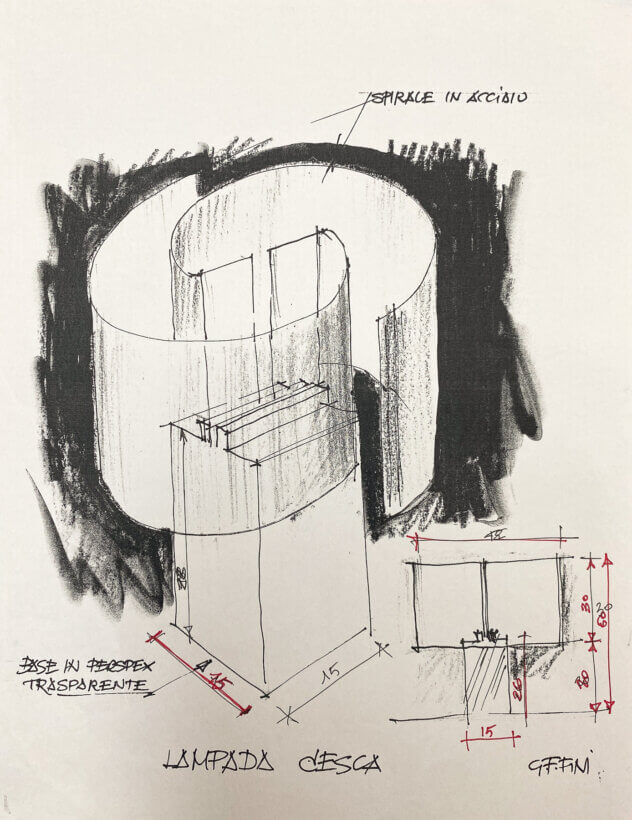 Cesca table lamp, designed by Gianfranco Fini and manufactured by New Lamp. “I dedicated Cesca to my daughter Francesca. It’s a beautiful invention. I took two identical shapes standing like this with two tie rods on either side; two small tubes with a screw inside, which tightens and distances the two sides. Compared to the usual lampshade it is divided; there are two semi-circular shapes that create an almost circular shape. The perspex base is also very beautiful, because it contrasts with the steel above. A very elegant lamp.” Original drawing by Gianfranco Fini (Picture by Palainco).
-
“I started to study architecture, and shortly after I began working. What happens is that all the architecture students go and work in studios, where they’re paid very little, because of course at first one is not able to work yet. But you learn a lot; in some ways more in studios than at university. And I, in particular, always had the ability to be very quick at drawing compared to others. It’s a skill, for which I got paid well. They asked me to collaborate when they had problems, for example when there were cultural competitions, national or international, for example for some museum.
Since I had more success than others in this area without officially being an architect and working permanently in a studio as head of the office, everybody came to me, and not to the owner to ask what they should do.”
Did you work on the lamps in the studio?
“Yes. In my third year at university I was already working with Cocchia [Fabrizio Cocchia—Palainco], but I was the one who made the lamps. He wasn’t very good, but above all he was very lazy.”
Then why did you continue to work with him?
“I was his slave, but I could work with him as his equal, despite the fact that officially I wasn’t an architect yet. Many lamps were signed by both of us, but I was the one who actually designed them. There were also lamps that were signed only by me, but this was done only after he took two lamps to Vento that were signed only by him. It was a strange period in which I continued to work as an architect without being one, suffering quite a lot because of the situation. It took me twenty years to graduate.”
-
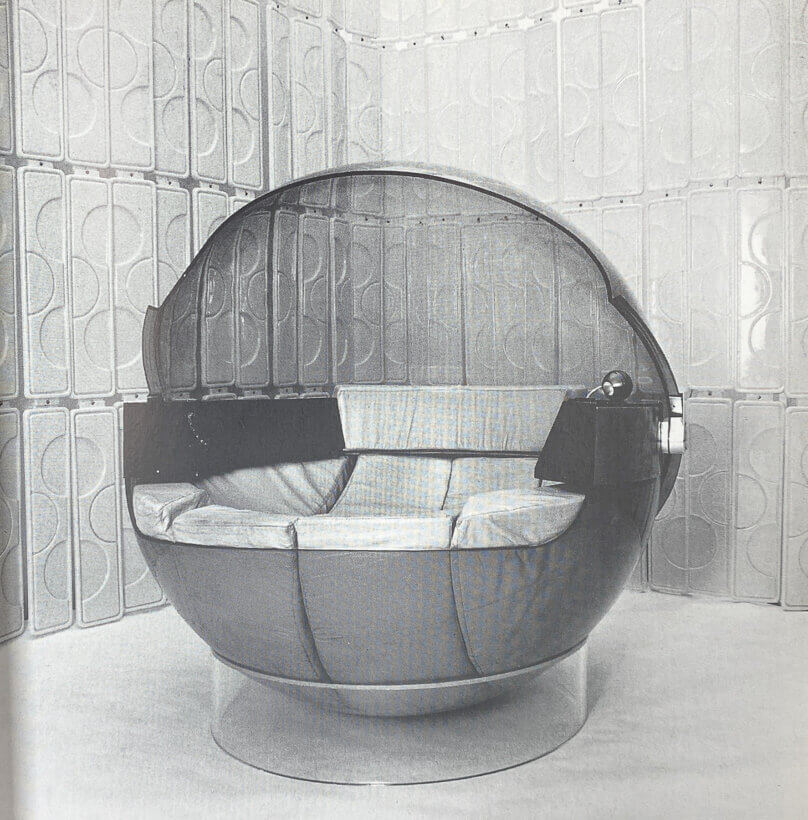 Lounge chair Monade, designed by Gianfranco Fini as exhibited at Mana Art Market by Nancy Marotta in Rome, 1969. Monade is a spherical chair with a pink, blue purple tinted plexiglass dome, built-in telephone, radio, bar, ashtray and reading light. If desired a television set can be installed.
The curtains in the background are by Paolo Scheggi.
Lounge chair Monade, designed by Gianfranco Fini as exhibited at Mana Art Market by Nancy Marotta in Rome, 1969. Monade is a spherical chair with a pink, blue purple tinted plexiglass dome, built-in telephone, radio, bar, ashtray and reading light. If desired a television set can be installed.
The curtains in the background are by Paolo Scheggi.
-
“The lounge chair Monade is the first thing that I did in the field of design, a beautiful thing. It was designed for Mana Art Market, which was rather strange and important in that era in Rome. The idea was for artists to design objects for the home, to make it a place for imagination. And there were some interesting things; there were doors made by Fontana and Castellani [Lucio Fontana and Enrico Castellani—Palainco]. And also my lounge chair, which was extraordinary. It was really molto fuori dal comune [very out of the ordinary—Palainco], boasting a phone with a rotary dial and a light. It was very scenic.”
It probably also felt very special to sit inside?
“Yes! And its success was enormous; it got a lot of attention in the foreign press, as well. Even the MoMa in New York wanted to have it in their collection. [However, Gianfranco Fini never followed up on the invitation of the museum to ship the object to New York, due to complicated shipment and the high shipping costs that had to be borne by him—Palainco]. It didn’t go into production though because it was very complicated to make. And of course, now it would be obsolete since everybody has a mobile phone.”
You also used methacrylate for Quanta, to great effect, don’t you agree?
“Quanta è bellissima…!”
Yes, absolutely!
“… it’s very simple, and very beautiful, but it was less successful than Programma. It’s a box-shaped sheet steel with inserted methacrylate cylinders. The small cylinders are made of sandblasted white Perspex, since they must spread the light. The cylinders expand the light laterally. If the cylinders would not be sandblasted, the light would come out straight. Inside there are little fluorescent circles that illuminate, obviously there were no LED lights yet.”
-
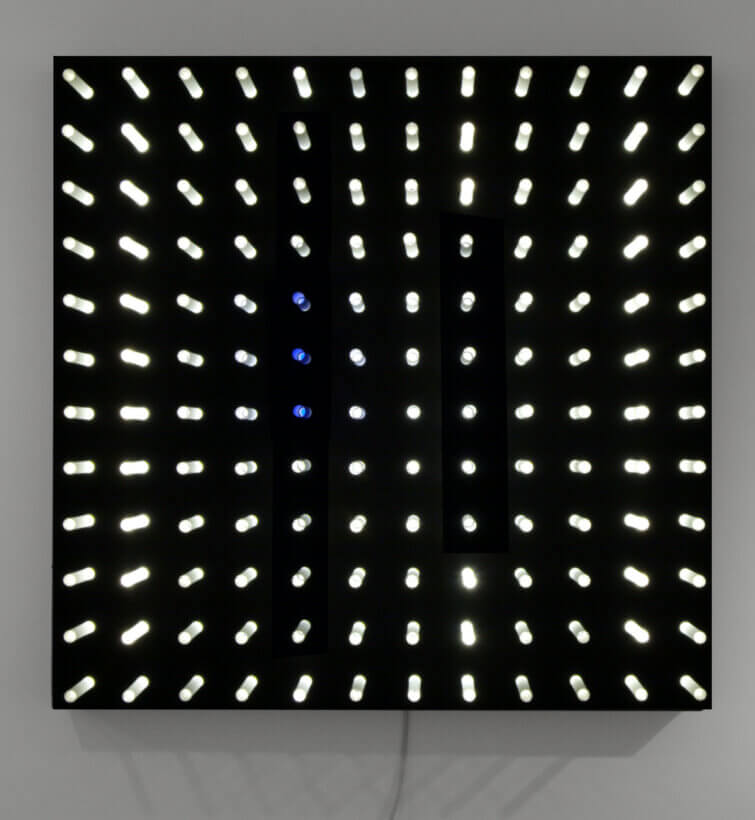 Lighting sculpture Quanta, designed by Gianfranco Fini and manufactured by New Lamp, circa 1970. Quanta consists of a steel sheet box with 144 sandblasted methacrylate cylinders inserted (Liliane and David M. Stewart Collection. Picture by The Montreal Museum of Fine Arts, Christine).
-
You made drawings of your ideas; how did the craftsmen that you worked with react to them?
“They were enthusiastic. They used to call me: ‘Maestro, maestro!‘”
Did they understand what you wanted right away?
“Sure. For them—their work was quite boring before I came—it was great to be able to do something so extravagant, that was also successful. Moreover, I wasn’t just some customer, a lady who wanted a lamp, who went there to piss them off. I was an architect. Or even if by chance I hadn’t graduated yet, which wasn’t important, I presented myself as an architect and so there was an enormous respect for what I said. And if by chance something couldn’t be done, I could understand what could be changed to make it possible. It was fantastic.
Craftsmen are a very special category in Italy and in the world. They are the ones who taught me more than university. They are taught by masters, who in turn were taught by other masters, in a fantastic tradition that has existed since the Middle Ages. Who built all those cathedrals? The grandfather, the father, then the son, the grandson, who in turn passed on the craft. It became a kind of super university; for the artisans that worked metal it was the same as it was for painters. From the 1500s one started to clean the floor, and would then do some welding, and slowly it became a school. It still exists in Italy. It wasn’t invented overnight.”
Does it mean that this was a happy episode for you?
“Yes, because we had a good relationship. They would say ‘Maybe it’s better to do it this way.’ And I often said: ‘Tell me how to improve it, how can I do this the way I want?’ And they would explain it to me.”
“I made these things for myself, and I was already very happy that they were made.“
How many craftsmen worked in the factory?
“There were seven or eight people, no more. They made more or less all of the lamps for New Lamp in that factory. For each model they made very few pieces, all manually, not in an industrial grade like the big lamp factories do.
I was surprised because when I showed up with these things I thought they were very complicated to do. The prices they reached later depend on the fact that there are so few pieces made. By the way, I don’t think that I ever received una Lira for these things.”
That doesn’t seem right!
“When you’re making lamps in large numbers, it’s only right to receive royalties. But I made these things for myself, and I was already very happy that they were made.”
-
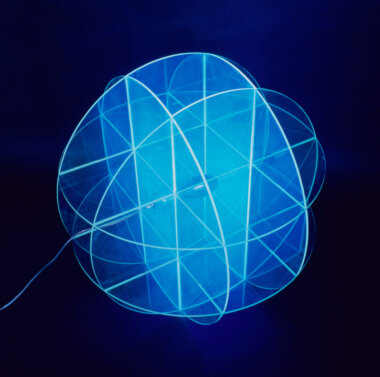 Lighting sculpture Quasar, designed by Gianfranco Fini for New Lamp. Quasar is a sophisticated construction of six intersecting methacrylate discs, forming a sphere (Picture courtesy of Fulvio Ferrari).
-
How did you get in touch with Mario Vento?
“I don’t recall if he looked for me, or I looked for him. I think that someone talked about him, because I vaguely remember hearing that there was this person who was looking for designers to make modern lamps. Maybe I called him to propose collaborating, or maybe he was informed that I was available and he called me. I don’t remember.”
What was Mario Vento like?
“He was an extremely simple man who spoke Romanaccio. He was very competent and he wasn’t afraid of anything. And he was likeable. We had a very good relationship. He was also qualified from a commercial point of view; the stand that we had in Milan [at the Salone del Mobile—Palainco] was well done. And he understood very well that these were not industrial products, that they were to be produced in small series.
I don’t know if by chance he had inherited this workshop, or that it was his own workshop, which made ugly lamps, modern classics, really very ugly things in iron. At a certain point maybe someone said something to him or he understood that it could be interesting to make modern things. He founded this company, which, not surprisingly, he called New Lamp. Evidently, he was very open to any type of proposal.
He needed objects, and what I made worked well and sold well. So he wanted me to make designs. And I wanted to do design, for which there wasn’t much opportunity in Rome.
It is very relative though, the design that I have done, compared to the Milanese designers, that were real designers. I call my lamps sculture luminose [in English: luminous sculptures—Palainco], lamps that are bit strange.” -
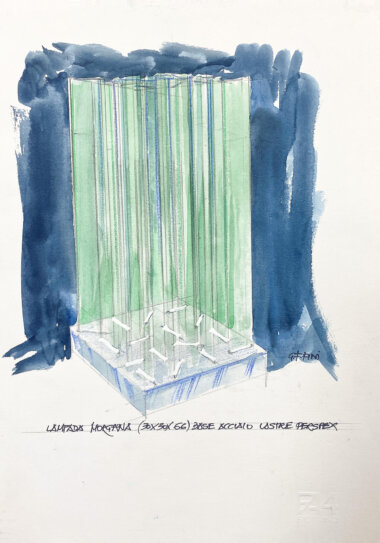
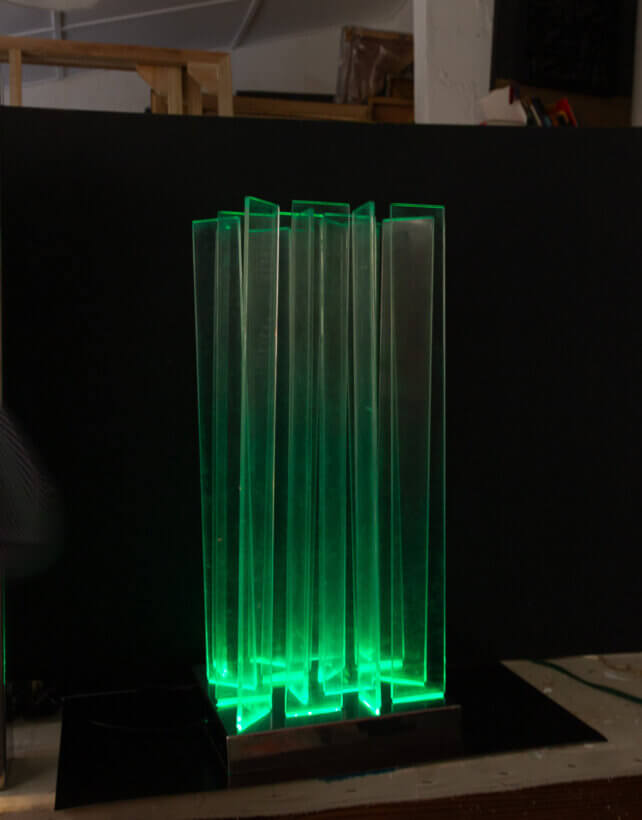 Above: Lighting sculpture Spaziale by Gianfranco Fini, manufactured by New Lamp, circa 1970 (Picture by Palainco). Below: Spaziale, original drawing by Gianfranco Fini (Picture by Palainco).
-
-
This also goes for Spaziale, which we saw in your studio yesterday. Where did the inspiration come from?
“Spaziale was born from a sculpture I had made and I kept in my small bachelor apartment It was a small attic in Via dei Coronari in Rome where I later lived with my wife. I had a lot of parties there at the beginning of the era. I welcomed Alberto Moravia, and many other important people, because it was an open house, everyone knew it. There were great spaghettate and discussions.
The sculpture appeared in a magazine that published an article on my home. It had an aluminium base [he starts drawing the sculpture] on which two wings were inserted with screws, one like this, another like this, aluminium sheets. One aluminium sheet in this direction, and the other in another direction. And then the other plates behind them.
I made the lamp exactly like the sculpture. It has a steel box as a base, and the sheets are made in light green methacrylate.
I went several times to the Salone del Mobile to sell. The first time we went I was really perplexed that people would buy these things [We laugh at hearing this]. The few times I was there, the majority of the lamps that were on display were made by me.”
What was, according to you, the set of factors that led to the extraordinary results?
“Mario Vento wasn’t stupid, he understood that it was an interesting trend from a commercial point of view. He had the courage to start the company that was not coincidentally called New Lamp. After the first Salone he saw that it was successful. My lamps were famous, which he hadn’t expected. And he became famous, which was unexpected as well. He believed in me and others, and saw that they were successful–my lamps.”
In the end your collaboration with Mario Vento only lasted a few years.
“One, two, maximum four years.”
It is not exactly clear how the collaboration with New Lamp ended, as Fini at a certain moment went to Brazil to work on a large project. But it was not due to a lack of enthusiasm.
“Certainly, he wanted to continue if there was a demand for the lamps, but then he passed away and so they were no longer made.”
And now, many years later you are here, far from your beloved Rome, in the Dominican Republic. What’s life like over here?
“Casa de Campo is a place that has extraordinary characteristics. I believe that there is no place in the world with the quantity of modern villas that are being distributed here, with so many golf courses, polo fields and tennis courts. At the moment we have twenty-three villas under construction… However, it’s not an intellectual environment, like I used to have in Rome, with my artist and architect friends, with all those dinner parties and stuff. It was a special period, and I was aware of that at the time. I miss that over here.”
-
- Palainco wishes to thank: Gianfranco Fini, for his enormous generosity and friendship.
Unless otherwise stated, all material is sourced and/or generated internally. All rights reserved.
- Text: Palainco, Koos Logger & Ingrid Stadler
- Image sources: Courtesy of Gianfranco Fini, Courtesy of The Montreal Museum of Fine Arts, Courtesy of Fulvio Ferrari, Palainco: Koos Logger & Ingrid Stadler
The article and its contents may not be copied or reproduced in any part or form without the prior written permission of the copyright holders.
Published on: 17 January 2025